Thailand Investment Visa

Keller Henson Team
Published on April 6, 2026
Thailand has just made long-term residency more accessible than ever. As of October 2025, the government introduced a revamped Thailand investment visa, lowering the minimum real estate investment threshold from 10 million THB to just 3 million THB, a major shift that opens the door to a much wider range of foreign buyers.
Designed specifically for international investors, this program stands out among Thailand long stay visa options by allowing buyers to secure extended residency through property ownership at a significantly lower entry point than ever before. As a Thailand long term visa, it offers a practical pathway for those looking to combine real estate investment with the freedom to live in the country.
Whether you're seeking a second home, a rental income opportunity, or a long-term lifestyle move, this visa represents one of the most accessible routes to living in Thailand today.
In this guide, Keller Henson explains everything about the Thailand long stay visa you need to know, from eligibility and costs to application steps and real advantages.
If you're new to the market, we recommend reading our complete guide on how to buy property in Thailand as a foreigner to understand ownership rules and legal structures.
What is the Thailand Investment Visa?
The Thailand Investment Visa, often referred to as the Thailand Long Stay Visa, is a residency program specifically designed for foreign nationals who invest in Thai real estate. It provides a straightforward pathway to long-term residence in Thailand through property ownership.
At its core, the program is built on a simple principle: by investing in property with a minimum value of 3 million THB, foreign buyers become eligible for a 1 year renewable long-stay visa, allowing them to legally reside in Thailand for extended periods. This structure makes it particularly attractive for those seeking both a secure investment and a stable living arrangement in the country. According to the official program framework, the visa is targeted at international real estate investors, reinforcing Thailand’s strategy to attract foreign capital into its property market while offering tangible lifestyle benefits in return.
Unlike short-term tourist visas, which require frequent renewals and offer limited flexibility, the Thailand Investment Visa is designed for long-term living. This makes it an ideal solution not only for property investors, but also for individuals looking to relocate or spend extended time in Thailand while enjoying the benefits of owning real estate in one of Southeast Asia’s most dynamic markets.
Thailand Investment Visa Eligible Projects by City
Here are the projects available for purchase under the Thailand investment visa criteria in the main cities:
Bangkok
Phuket
Pattaya
Hua Hin
What are the conditions of the Thailand Investment Visa?
To qualify for the Thailand Investment Visa, applicants must meet a set of clearly defined investment criteria centered around real estate in Thailand. The program is designed to remain accessible while ensuring that applicants make a genuine financial commitment to the local property market.
The primary requirement is a minimum investment of 3,000,000 THB in real estate. The unit purchased or leased must be acquired from a Thai owner or Thai entity with a majority of Thai ownership (more than 51%). This investment can take several forms, offering flexibility depending on the buyer’s objectives. Applicants may choose to purchase a freehold condominium, acquire a leasehold property, or in some cases, qualify through a long-term rental arrangement. It is important to note that properties under construction are not eligible until they are fully completed and officially registered.
There are three main pathways through which applicants can meet the investment requirement:
The most common option is the purchase of a freehold condominium unit. In this case, the buyer must acquire a unit from a Thai owner or Thai entity, within a registered condominium building, with a purchase price of at least 3 million THB. The transaction must be supported by a valid purchase contract and an official condominium title deed bearing the applicant’s name.
Alternatively, applicants may choose a leasehold investment, either for a condominium or a house. The lease must have a minimum duration of three years, and the total lease value must be at least 3,060,000 THB if 3 years lease (equivalent to 85,000 THB per month). Supporting documents include the lease agreement, proof of payment, and the property title deed clearly identifying the applicant.
A third, less common route is through long-term rental. This requires a monthly rental value of approximately 85,000 THB, along with advance payment. Typically, at least three months’ rent must be paid in advance for the initial immigration stage, and up to twelve months for the long-stay visa stage. Applicants must provide clear proof of these payments to the property owner.
What are the required documents for each type of investment route?
The documentation required for the Thailand Investment Visa depends on the type of investment chosen. While some standard documents apply to all applicants, additional requirements vary depending on whether the investment is made through property purchase or rental.
For applicants purchasing a freehold condominium unit, a set of standard administrative documents must first be prepared. These include a completed visa application form and a copy of the applicant's passport. In addition, proof of ownership is essential. This typically consists of the condominium sale and purchase agreement, along with payment evidence such as bank transfer records or official receipts. The title deed (chanote) must clearly show the applicant's name, confirming legal ownership of the property. Applicants may also be required to provide a map indicating the location of the condominium building.
Visual documentation is also part of the process. Applicants must submit photographs of themselves taken at the property, including in front of the condominium building, at the entrance of the unit (with the room number clearly visible), and inside the unit to show the interior. These images serve as supporting evidence of the investment and occupancy.
Standard Documents for condominium purchasers
Visa Application Form
Copy of the applicant's passport
Ownership proof
Condo Sale & Purchase Agreement
Payment evidence (transfer/receipts)
Title Deed showing applicant's name
Map showing the building's location
Required Photos
Must provide photographs of the applicant at:
Front of the condominium building
Front of the room (must clearly see the room number)
Inside the room (interior)
For those applying through a rental or lease agreement, the requirements focus on the contractual and financial aspects of the tenancy. The lease agreement must clearly state the applicant as the tenant and must meet minimum duration requirements, typically at least one year for rental eligibility, and no less than three years for leasehold arrangements. In addition, the status of the landlord is important. The lessor must be either a Thai individual or a juridical entity with majority Thai ownership (more than 51%). Applicants must also provide proof of payment, demonstrating that rent has been paid in advance at a minimum threshold of approximately 85,000 THB per month, usually covering at least three months & up to 1 year advance rent payment.
Disclaimer: The application process for the Thailand investment visa through rental and leasehold arrangements is valid and can be completed. Although the authorities are currently revising the rules due to misuse, it remains possible to apply.
Standard document for Lease Agreement
Duration not less than 1 year
Duration for Leasehold: No less than 3 years
Must specify applicant as "Tenant"
Landlord & Payment
Lessor Status: Thai Individual OR Juridical Person (Thai majority shareholding > 51%)
Payment Proof: Receipt of advance rent (≥ 85,000 Baht/month) for at least 3 months & up to 1 year advance rent.
Who is eligible for the Thailand Investment Visa?
The Thailand Investment Visa is open to every foreign nationals from around the world, making it an accessible option for international investors seeking long-term residence in Thailand. However, eligibility is subject to specific conditions, particularly when including family members in the application.
For an individual applicant, the requirements are straightforward. The applicant must meet the minimum investment threshold of at least 3 million THB in qualifying real estate and must be able to demonstrate legal ownership or a valid lease agreement in their name. This ensures that the applicant has a direct and verifiable investment in the Thai property market.
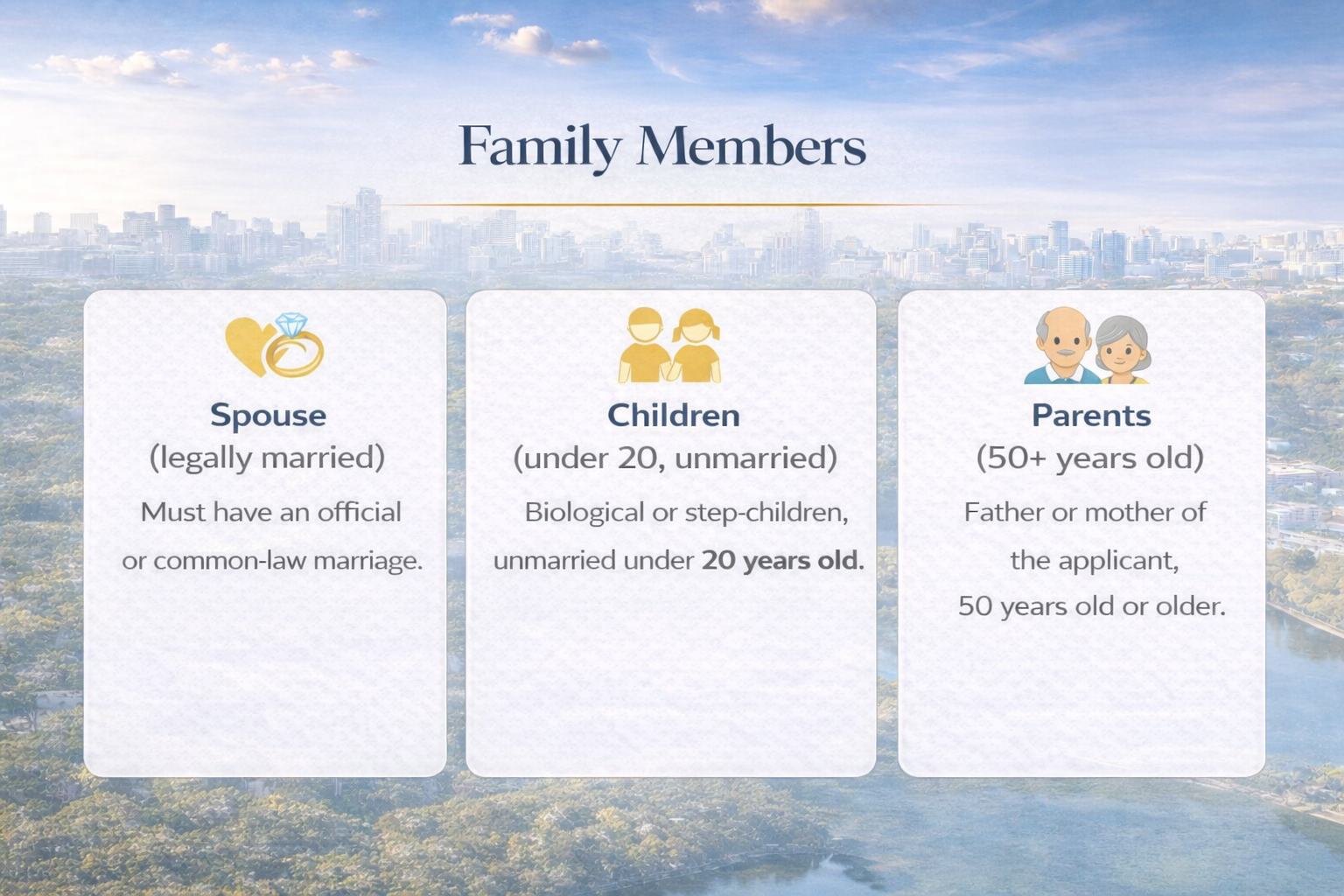
In addition to the main applicant, the program allows certain family members to be included under the same visa framework. Eligible dependents typically include a legally married spouse, children under the age of 20 who are unmarried, and parents of the applicant who are aged 50 or older. This structure makes the visa particularly attractive for those planning to relocate with their immediate family. When applying with dependents, applicants must provide official documentation proving the relationship, such as marriage certificates for spouses or birth certificates for children and parents. If these documents are issued outside of Thailand, they must be officially translated into Thai to comply with local administrative requirements.
What is the application process?
Applying for the Thailand Investment Visa follows a structured, step-by-step process designed to ensure that all investment and immigration requirements are properly met. While the procedure involves several stages, it is relatively straightforward, especially when guided by experienced professionals.
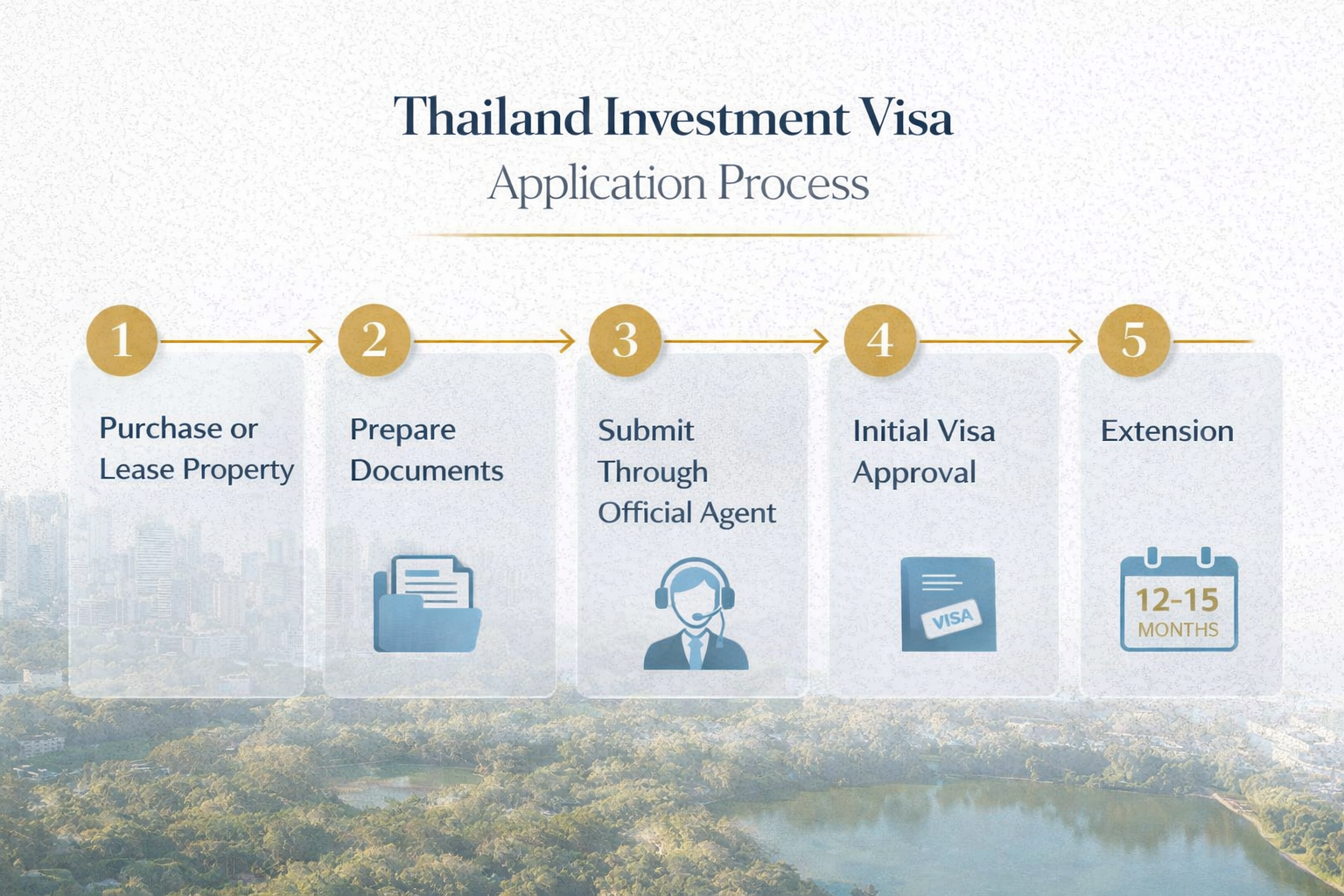
The first step is to purchase or lease a qualifying property. The investment must be completed under the applicant's name, with all legal documents properly issued. This includes signing the contract, completing the payment, and obtaining either the title deed (for purchases) or a valid lease agreement (for leasehold or rental options). Ensuring that all documentation is accurate at this stage is critical, as it forms the foundation of the visa application.
Once the investment is secured, the next step is to prepare the required documents. Applicants must gather a copy of their passport, a completed visa application form, and all property-related documents such as the purchase contract, title deed, or lease agreement. Proof of payment, including transfer records or receipts, is also required. In addition, applicants must provide photographs of the property, including the building, the unit, and the interior, as part of the supporting evidence.
A key stage in the process is obtaining TLS certification, which is handled through Thailand Longstay Service (TLS), the sole authorized government partner for this visa. Every application must receive a certification letter from the Ministry of Tourism and Sports via TLS. This step is essential, as it confirms eligibility under the 3 million THB investment scheme. At Keller Henson, we help to coordinate this entire process on behalf of our clients, ensuring a smooth and hassle-free experience .
After submission and approval, applicants are granted an initial 90-day temporary visa. This serves as the entry stage before transitioning into long-term residency.
Before the initial visa expires, applicants must apply for an extension to the long-stay visa, which is typically granted for 12 months. It is important to complete this step on time to maintain legal residency status. Investors should also be aware that spending more than 180 days per year in Thailand may classify them as Thai tax residents, which could have implications depending on their personal financial situation. Finally, the visa is renewable on an annual basis, provided that all conditions - particularly the investment requirement - continue to be met. This renewal process ensures that the visa remains valid for long-term use.
What is the price of the Thailand Investment Visa?
The cost structure of the Thailand Investment Visa is relatively straightforward, making it an accessible option compared to many other long-term residency programs. However, it is important to understand that the total cost includes both the initial property investment and ongoing administrative fees.
The primary requirement is a minimum investment of 3,000,000 THB in qualifying real estate. This amount forms the foundation of the visa eligibility and must be maintained throughout the duration of the visa.
In addition to the investment, applicants must pay a Thailand Long Stay (TLS) membership fee, which is approximately 6,000 THB and is valid for up to 20 years. It is important to note that this fee applies only to projects that are in partnership with Thailand Longstay, and it may be subject to change depending on official policies.
There is also an annual visa application fee of 27,000 THB, which must be renewed each year through the TLS service and in accordance with immigration regulations. This recurring fee represents the main ongoing cost of maintaining the visa.
For applicants including family members, the cost increases accordingly. Each additional dependent, such as a spouse, child, or parent, requires a separate application, with an additional 27,000 THB per person per year.
In terms of renewal, the cost remains relatively consistent, with the same annual fee structure applied as long as the applicant continues to meet the program requirements. However, administrative or service fees may increase slightly over time due to regulatory changes.
It is also worth noting that some property developers offer incentives to attract foreign buyers. These may include discounted visa fees, fast-track immigration services, or assistance with the application process, particularly for the initial year. While these offers can reduce upfront costs, they are typically limited to specific projects and promotional periods.
How does the Thailand investment visa compare to other visa options?
Choosing the right visa is a crucial step for anyone considering property or long-term living in Thailand. Each option comes with different requirements, benefits, and levels of flexibility depending on your financial profile and lifestyle goals. Whether you are an investor, retiree, or seeking convenience, understanding how each Thailand investment visa option compares will help you make a more informed decision before moving forward.
Here are the most common visa options available in Thailand:
Features | 3M Investment Visa | Retirement Visa | LTR Visa (Wealthy / Pensioner) | Thailand privilege Visa |
Minimum requirement | 3M THB property | 800,000 THB deposit in a bank account or equivalent 65,000 THB monthly pension income | USD 80K income for pensioners or High assets 500K USD Investment into Thailand + Overseas asset value 1M USD | Membership fee only. 900,000 THB to 5,000,000 THB depending on the duration (5 years up to 20 years) |
Type of investment | Real estate only | No specific investment needed | Real Estate +Financial+income-based | No investment required |
Visa duration | 1 Year (Renewable) | 1 Year (Renewable) | 10 Years (5+5) | 5-20 Years |
Tax benefits | Standard Thai tax | Tax excemptions on overseas income | Tax excemptions on overseas income | No tax benefits |
Work permit | Not allowed | Not allowed | Digital work permit can be allowed | No |
Ease of application | Easy | Easy | Complex (BOI approval) | Very easy |
Family Inclusion | Yes | Yes | Limited (Spouse + Children) | Yes at additional fee |
90-Day Reporting | Every 90 days | Every 90 days | Once per year | Handled / assisted |
Best for | Property investors | Retirees | Wealthy retirees & wealthy profesisionals | Lifestyle & convenience |
Why invest through the Thailand Investment Visa?
The Thailand Investment Visa is more than just a residency permit, it is a strategic tool that combines long-term living benefits with tangible financial returns through real estate.
One of the main advantages of this visa is the flexibility of long-term stay. Unlike tourist visas, which require frequent renewals and impose limitations on duration, the Thailand Investment Visa allows for continuous residence with a simple annual renewal process. This makes it ideal for those who want stability without complex immigration constraints. Beyond residency, the program is directly tied to real estate ownership, meaning you are not simply paying for a visa - you are acquiring a valuable asset. Investors benefit from potential capital appreciation, the ability to generate rental income, and access to one of Southeast Asia's most dynamic property markets. Thailand's real estate sector continues to grow steadily, offering both short-term returns and long-term value.
The visa also provides strong lifestyle advantages, particularly for those looking to relocate or spend extended time in the country. A key benefit is the ability to include immediate family members under the same visa structure, making it a practical solution for families rather than just individual applicants.
In addition, visa holders can open a Thai bank account, which is essential for managing property-related transactions, receiving rental income, and handling daily expenses locally. This significantly simplifies financial operations for foreign investors.
Another important advantage is the program's simplicity. Compared to elite residency schemes or business visas that often require high capital thresholds or complex financial structures, the Thailand Investment Visa offers a clear and accessible entry point based solely on property investment. From an investment perspective, Thailand, particularly Bangkok, Pattaya, Hua Hin & Phuket, continue to attract strong interest due to its growing economy, increasing tourism, and consistent rental demand. These factors contribute to ongoing capital appreciation and make the market especially appealing to foreign buyers.
Many investors choose the capital due to strong rental demand, explore current Bangkok real estate investment opportunities to see available projects.
Finally, an often-overlooked but critical aspect of the process is the mandatory TLS certification. The 3 million THB investment pathway requires official validation through Thailand Longstay Service (TLS). As an authorized partner, Keller Henson manages this step directly on behalf of clients, ensuring that applications meet all requirements from the outset and avoiding complications with immigration authorities.
When can you apply for the Thailand Investment Visa?
You can apply for the Thailand Investment Visa as soon as your property investment is completed and properly documented. In practical terms, this means that once you have signed the contract, completed the payment, and obtained the title deed or lease agreement in your name, you are eligible to begin the application process.
The program applies to properties that have been purchased from October 2020 onward, making it accessible not only to new buyers but also to existing owners who meet the criteria. This flexibility allows investors who have already entered the Thai real estate market to benefit from the visa without needing to make an additional purchase.
Both ready-to-move-in properties and off-plan developments are eligible. However, it is important to note that off-plan units typically qualify only once construction is completed and the property is officially registered, as full ownership documentation is required for the application. While the visa itself is not limited to new purchases, certain developer promotions, such as discounted visa fees or application support, may only apply to newly booked units. As a result, timing can play an important role in maximizing both financial and administrative benefits.
Conclusion: Is the Thailand Investment Visa worth it?
For foreign investors looking to combine real estate ownership with long-term residency, the Thailand Investment Visa stands out as one of the most practical and cost-effective options available.
With a relatively low entry threshold of 3 million THB, the program offers a compelling balance between accessibility and value. Rather than simply paying for residency, investors gain both legal status in Thailand and ownership of a tangible asset.
This visa provides a clear pathway to long-term residence, supported by straightforward renewal conditions, while also allowing investors to secure property in a growing market. In addition to the potential for capital appreciation and rental income, it offers a level of investment security that many other visa programs do not.
At the same time, it delivers significant lifestyle flexibility, making it ideal for those who want to live, retire, or spend extended periods in Thailand without the limitations of short-term visas.
While the Thailand Investment Visa offers clear residency advantages, investors should also understand the financial side of ownership, including property tax in Thailand for foreigners, which remains relatively low compared to other global markets.
At Keller Henson, we specialize in helping foreign buyers navigate both property acquisition and visa processes seamlessly. If you're considering investing in Thailand, our team can guide you from property selection to visa approval, ensuring a smooth and secure experience.
FAQs: Thailand Investment Visa
To qualify for the Thailand Investment Visa, applicants must invest at least 3 million THB by purchasing a freehold condominium, acquiring a leasehold property, or entering into a qualifying long-term rental agreement.
Yes, only parents and children of the main applicant are eligible.
Spouse’s parents are not included.
Yes, as long as the purchase was made after October 2020.
No. Both new and resale properties are eligible, as long as acquired from a Thai individual or a Thai juridical entity with majority Thai ownership (more than 51%).
It appears as a standard visa stamp, without mentioning the investment amount.
Yes. This visa allows you to open a Thai bank account, which is essential for managing your investment. TLS will support for the bank account opening with a letter adressed to the Thai bank. The bank & branch cannot be chosen by the applicant.
The same documents as the initial application are required, including proof of property ownership.
The visa must have at least 20 days of remaining validity.
The client is not required to provide a bank statement. Only the property documents are required.
Yes, it can be renewed every years However, the documentation & application fee must be submitted again at the time of renewal. Starting from June 2026, the membership fee will be adjusted to THB 6,000.
Yes, a re-entry permit is required. It's possible to purchase a single or multiple re-entry permit.
If the 2nd owner is a dependant, it's only required to share the dependant's document. If the 2nd owner is not a dependant, the unit must have a value of at least 6 million Thai Baht as the value will be divided equally in between the buyers.
Yes, Client B can apply.
No. Foreign buyers are not required to be listed in a house book. The title deed (chanote) with your name is sufficient.
Yes. You can combine multiple properties.
Example: 2 condos worth 2.5M THB each = 5M THB total → eligible.
Yes, foreign buyers can legally own condominium units as freehold ownership in Thailand.
the application fee to be paid to the immigration of Thailand is per applicant - if add kids or spouse must pay 27,000 THB per relative applicant